

What is divorce mediation?

Divorce mediation is a structured process in which a neutral third party — the divorce mediator — helps separating spouses reach their own agreements on the issues that need to be resolved, such as parenting arrangements, child support, spousal support, division of property and debts, and anything else that is part of their separation. The mediator does not make decisions for the parties. Their role is to facilitate productive conversation, help each person understand their options, and guide both parties toward agreements they can both accept.

Mediation is one of several alternative dispute resolution (ADR) processes recognized under Canadian law, alongside litigation, collaborative law, arbitration, and Med/Arb. It is the most widely used alternative to court-based divorce process, and in most provinces, family justice services now actively encourage or even require parties to attempt some form of ADR before proceeding to litigation.

A successful mediation results in a memorandum of understanding or draft separation agreement that both parties take to their own lawyers for independent legal advice before signing. The signed separation agreement is a legally binding contract.

Source: Justice Canada – Fact Sheet - Family dispute resolution: resolving family law issues out of court

Here are some questions you may be asking yourself:

  • "What does a divorce mediator actually do?"
  • "How is mediation different from going to court?"
  • "Is mediation cheaper than hiring a lawyer?"
  • "What if my spouse won't cooperate in mediation?"
  • "Can mediation work if we have children or significant assets?"
  • "Is a mediated agreement legally binding in Canada?"
  • "When is mediation not appropriate — for example, if there has been abuse?"
  • "How long does mediation take?"

All these questions and more will be answered on this page!

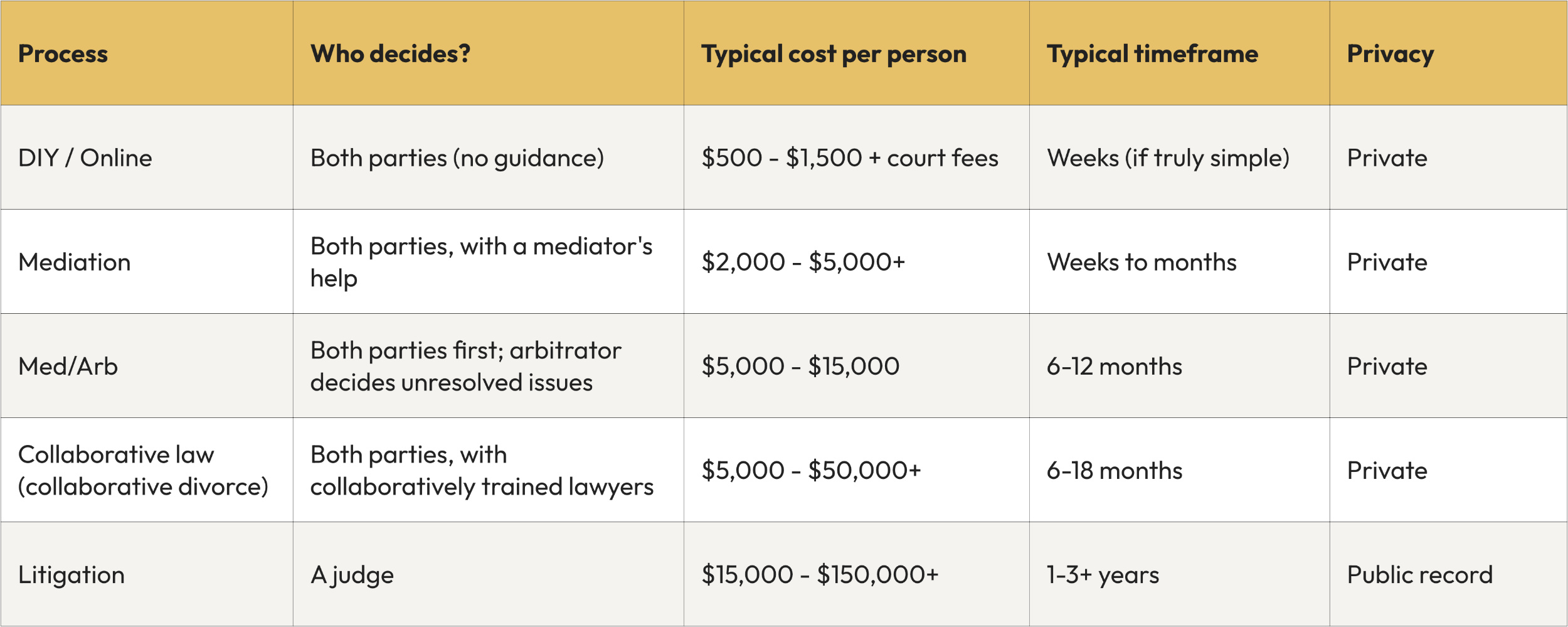
Overview of family dispute resolution processes recognized under Canadian law

Understanding what makes the family mediation process distinct helps clarify when it is likely to work well and when it may not be the right fit.

Litigation and Collaborative Law represent the highest-cost end of the spectrum, and once divorce proceedings begin in court, they are difficult to exit. The cost can vary substantially based on the complexity and on how adversarial the negotiations are.

Do-It-Yourself (DIY) is only appropriate for very simple situations, when there are no children and no significant shared assets, and when both parties are already in full agreement. As complexity increases, so does the risk of gaps, missed obligations, or agreements that banks and courts will not honour.

Mediation covers the full range from simple to financially complex. It typically costs significantly less than litigation, takes considerably less time, and keeps decisions in the hands of the parties rather than a judge. It also tends to produce outcomes both parties feel more ownership over, which has practical benefits for co-parenting relationships that will continue for years after the divorce is finalized.

Med/Arb adds the certainty that a binding decision will be reached if negotiation stalls, though it carries its own trade-offs (see FAQs).

Source: Justice Canada – Family Dispute Resolution: Processes and Outcomes
Source: Family Mediation Canada - Separation & Divorce 


What a mediator does, and does not do

What a mediator does

  • Creates a structured, neutral space for both parties to discuss and negotiate
  • Ensures both parties have the opportunity to speak and be heard
  • Helps identify each person's interests and priorities, not just their stated positions
  • Provides information about the legal framework and what courts would typically consider (though not legal advice)
  • Assists with financial disclosure so both parties are working from complete, accurate information
  • Drafts a memorandum of understanding or heads of agreement summarizing what the parties have agreed to
  • Screens for power imbalances and family violence before and during the process

What a mediator does not do

  • Make decisions or impose outcomes — the mediator has no authority to determine what the agreement says
  • Provide legal advice to either party (a mediator who is also a lawyer still cannot give individual legal advice in their mediator role)
  • Represent either party's interests
  • Guarantee that an agreement will be reached
  • Replace the need for each party to get independent legal advice before signing a final agreement

The key distinction: A mediator helps you reach your own agreement. A lawyer advises you about your rights and whether an agreement is fair. Both have important roles, and in most mediations, both are involved at different stages.

Interest-based vs. directive mediation: A distinction worth understanding

Not all mediation works the same way, and the difference matters, particularly for couples where there is a financial knowledge gap, a significant difference in personality or communication style, or a history of one partner dominating decision-making.

Interest-based mediation

The traditional model puts both parties in the same room and asks each to articulate their interests. The mediator facilitates the conversation and helps them find common ground. This works well when the couple can communicate reasonably, when power is relatively balanced, and when both have enough information to advocate effectively for themselves. When those conditions aren't met, joint sessions can actually amplify conflict because the more dominant or financially knowledgeable party tends to prevail, often producing an agreement the other party later regrets or even challenges.

Directive or structured mediation

A more directive approach guides both parties through a defined process, typically working with each person separately or in structured stages, rather than simply facilitating open-ended negotiation. The mediator brings financial expertise, sets the agenda, manages disclosure, and actively helps both parties understand the implications of proposed terms before they agree to anything. This model is better suited to complex finances, significant power imbalances, or situations where one party has limited knowledge of the household's financial picture.

Why this matters when choosing a mediator: Ask any prospective mediator directly: "Do you work with both parties jointly, separately, or both?" and "How do you handle situations where one party knows significantly more about the finances than the other?" The answers will tell you whether their approach fits your situation.

The mediation process: How it typically works

1

Understanding and preparation

Before any joint session, a responsible mediator meets with each party individually. These separate meetings serve two purposes: to understand each person's situation and goals, and to screen for family violence, power imbalances, and other factors that might make joint mediation unsafe or inappropriate. Screening is an ongoing obligation, not a one-time step.


2

Session format: joint or separate?

A key decision is whether sessions will be joint (both parties present with the mediator), separate (each party meets with the mediator independently, in sequence), or shuttle (parties are in different rooms or calls, with the mediator moving between them). These are genuinely different models:

  • In joint sessions the mediator facilitates face-to-face discussion.
  • In separate or shuttle formats each party has space to think and speak freely without the dynamic of the other person in the room, which often reduces pressure and leads to more considered decisions. 


3

Financial disclosure

For any agreement to be enforceable, both parties must fully disclose all assets, debts, and income. This is both a legal requirement and a practical necessity, since an agreement reached without complete financial information is at serious risk of being set aside by a court later. A good mediator ensures this process is completed before any financial terms are agreed to.

An important protection: what is said and disclosed during mediation is generally confidential and cannot be used as evidence in court if mediation breaks down. This means both parties can speak candidly and explore options without fear that tentative concessions or disclosed information will later be used against them in litigation. This confidentiality is one of mediation's most underappreciated practical benefits.


4

Memorandum of understanding

When the parties reach agreement, the mediator documents the terms in a memorandum of understanding (MOU) or draft separation  agreement. This is not yet a legally binding contract, but records what has been agreed so that each party can review it with their own lawyer.


5

Independent legal advice and final agreement

Each party takes the MOU to their own lawyer for independent legal advice (ILA). The lawyer reviews whether the terms are fair, whether any rights are being waived, and whether anything important has been missed. Once both parties are satisfied, a formal separation agreement is signed and the document becomes legally binding.

Source: Ontario Association of Family Mediators – The Mediation Process


When mediation works well, and when it doesn't

The parameters are narrower than most people fear

One of the most anxiety-reducing things to understand about divorce in Canada is that the range of possible outcomes is not as wide as you may think. Provincial property laws, the federal Child Support Guidelines, and the Spousal Support Advisory Guidelines collectively set a defined framework and provide the "goalposts" for what a fair resolution looks like. Everybody is bound by that framework, including mediators, lawyers and the court.

The practical implication is that you are not negotiating from scratch in an open field. You are working within a structure that already reflects what the law considers fair for your circumstances. For most couples, this means the final agreement will land in a relatively predictable range, however that agreement has been reached.. That makes the question less "what am I going to get?" and more "how do I get there with the least cost, time, and damage to my family?"

Conditions that support successful mediation

  • Both parties are willing to participate in good faith and engage honestly with the process.
  • Both parties are willing to make full financial disclosure.
  • There is no active safety threat or pattern of coercive control that cannot be safely managed.
  • Each party has, or is willing to get, independent legal advice alongside the process.
  • The parties can, with the mediator's help, communicate about the issues that need to be resolved.

Situations where mediation is unlikely to work

  • One party refuses to participate or is not acting in good faith. That could include agreeing to mediate while withholding information, using sessions to gather intelligence rather than negotiate, or deliberately stalling.
  • There is an active safety risk that cannot be adequately managed even with shuttle mediation and other safeguards.
  • One party has a history of using information disclosed in mediation as a weapon in other proceedings.
  • There are active criminal proceedings related to family violence.

The presence of family violence or significant power imbalance does not automatically rule out mediation, but it requires careful assessment. Properly trained mediators screen for these dynamics before any joint session and can adapt the process through shuttle mediation, support persons, or individual session formats. You should never feel pressured to participate in mediation you do not feel safe in. If you are uncertain, get independent legal advice first.

Source: Ontario Association of Family Mediators – Professional Standards, Including IPV Screening
The role of lawyers in mediation

Mediation and legal advice are not alternatives to each other. They serve different functions and work best together. A mediator helps you reach an agreement. A divorce lawyer tells you what your legal rights are, advises whether a proposed agreement is fair, and ensures the final document is properly drafted and binding.

Most mediators recommend that each party consult with a family lawyer if specific issues arise that require legal advice, and before signing any final agreement to review the terms. This is called independent legal advice (ILA), and while it is not strictly required by law in every province, agreements signed without ILA are significantly more vulnerable to being challenged or set aside later.

How much does mediation cost?

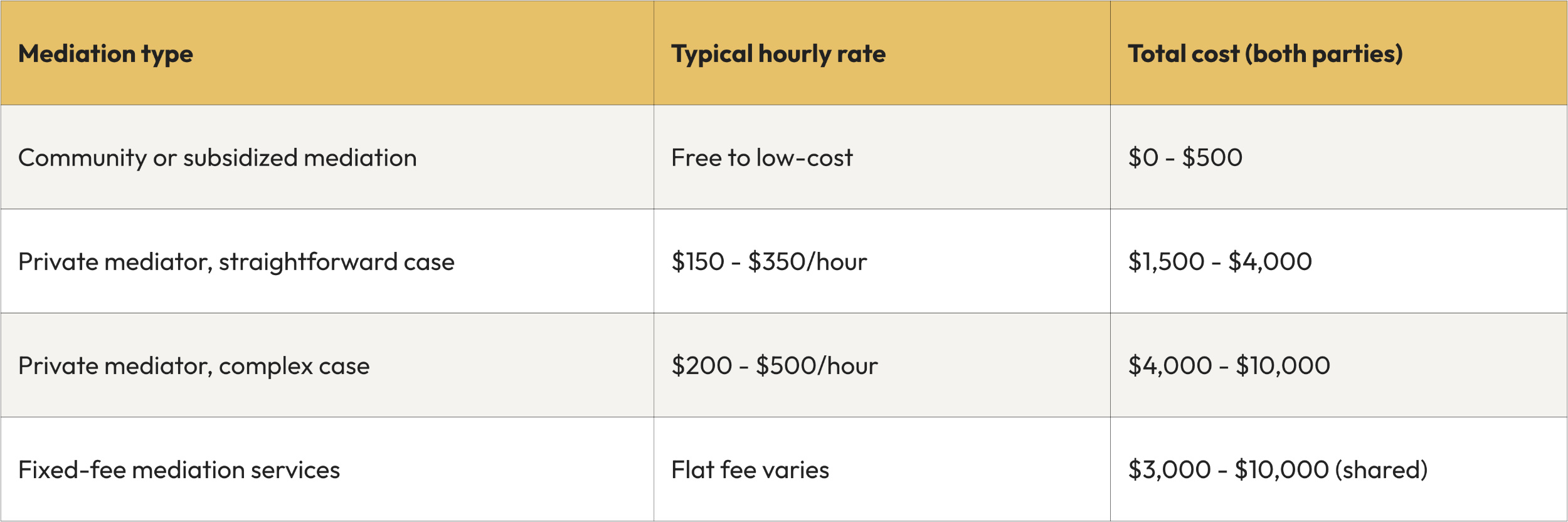
Mediation fees vary by mediator experience, location, and the complexity of the issues. Most mediators in Canada charge by the hour, and costs are typically shared between both parties. In some cases mediation services are on a fixed-price basis.

These figures cover the mediation itself and do not include the independent legal advice each party needs before signing, which typically adds $500–$2,000 per person for review of a straightforward agreement. Other professional fees, such as valuations, are also not included.

Even at the higher end, mediation is substantially less expensive than contested litigation. A modestly contested court case in Canada routinely costs $15,000–$50,000 per person in legal fees; high-conflict cases reaching trial can exceed $100,000 per person in legal fees. The cost comparison is one of mediation's most compelling practical arguments.

Subsidized and free mediation options

Several provinces offer government-funded or subsidized mediation for families who meet income eligibility criteria. Ontario's court-connected mediation program provides free mediation services at many family court locations. BC and Alberta have similar programs. Legal Aid offices in every province can provide referrals to low-cost or no-cost family dispute resolution options. Court-connected programs are available at most Superior Court family divisions — ask the court clerk or contact your provincial Legal Aid office.

How long does mediation take?

The timeline depends primarily on how many issues need to be resolved, how much agreement already exists, how quickly both parties can complete financial disclosure, and how available both parties and the mediator are for sessions.

  • Simple cases (short relationship, no children, limited assets, substantial agreement already in place): two to four sessions over four to eight weeks
  • Moderate complexity (children, property, some contested issues): four to eight sessions over two to four months
  • High complexity (business interests, pensions, significant contested issues, or high conflict): six to twelve sessions over three to six months or more

Even in complex cases, a couple will typically reach resolution through mediation faster than through litigation. The one-year separation period required in most cases before a divorce can be filed runs concurrently, so completing mediation within the first year of separation means a divorce filing can follow almost immediately after the separation period ends.

Choosing a mediator

In Canada, family mediators are not regulated in the same way lawyers are regulated, and there is no single national licensing body. However, several professional associations set training and ethical standards, and membership in one of these bodies is a meaningful indicator of quality:

A qualified family mediator will have specific training in family law, financial disclosure, parenting issues, and domestic violence screening — not just general mediation skills. Ask any prospective mediator about their training, experience with cases similar to yours, and approach to power imbalance and family violence.

Questions to ask a prospective mediator

  • What are your qualifications and professional memberships?
  • Do you conduct individual screening meetings before joint sessions?
  • What is your approach if there has been a history of family violence or coercive control?
  • Do you offer shuttle mediation?
  • What is your fee structure, and is a fixed-fee arrangement available?
  • How do you handle situations where one party is not disclosing fully?
  • Will you draft the memorandum of understanding, and do you recommend independent legal review?

Source: Family Mediation Canada – Find a Mediator

Common myths about divorce mediation

"Mediation means I have to compromise on everything."

Not necessarily. Mediation is a negotiation process. The goal is an agreement both parties can genuinely accept, not an arbitrary split down the middle. Outcomes can be more flexible than court orders, and parties often reach arrangements that better reflect their actual priorities than a judge would impose.

"I don't need a lawyer if I use a mediator."

The mediator's role and a lawyer's role are different and complementary. A mediator facilitates agreement; a lawyer advises you on your rights and whether an agreement is fair. Getting independent legal advice (ILA) before signing any mediated agreement is strongly recommended and mandatory in some provinces. Declining to get ILA significantly weakens the agreement's enforceability.

"Mediation is only for amicable divorces."

Mediation does require a basic level of willingness to engage, but it can work in high-conflict situations with appropriate structure. If necessary, a type of mediation where parties don’t meet face to face may be used. Research supports mediation even in cases involving intimate partner violence when properly screened and structured.

"If mediation fails, I've wasted my money."

Partial mediation is common and valuable. Parties often resolve some issues through mediation and litigate only the ones they cannot agree on, which significantly reduces legal costs. Even an unsuccessful mediation typically narrows the issues, which reduces the time and cost of any subsequent court process.

"A mediated agreement isn't as legally binding as a court order."

A properly executed separation agreement is a legally binding contract in Canada as long as it complies with the requirements. In some provinces that means it needs to be reviewed by lawyers for both parties. A separation agreement can be filed with the court and enforced. Parenting and support terms can be reviewed by a court if circumstances change significantly, just as court orders can be varied.

Provincial differences

While family law mediation follows broadly similar principles across Canada, there are some provincial variations worth knowing:

  • Ontario has court-connected mediation programs at most Superior Court family divisions, mandatory information sessions (MIAM) before certain proceedings, and detailed professional standards through OAFM. The Family Law Act governs domestic contracts including separation agreements.
  • British Columbia offers FamilyMediation.ca and court-based family justice counselling services at no cost. BC's Family Law Act explicitly encourages parties to use family dispute resolution before going to court.
  • Alberta has the Family Mediation Alberta network and court-connected services through provincial family justice centres. Mediation is encouraged before contested hearings.
  • Quebec is the most distinctive: qualifying separated couples (married or de facto) with children are entitled to six free mediation sessions under the government's family mediation program, and a memorandum must be prepared before the court will issue most parenting orders. Quebec's civil law framework differs from common law provinces.
  • Other provinces and territories have varying court-connected programs and professional associations. Contact your provincial Legal Aid office or family court registry for local options.

Considering mediation for your separation?

If you'd like to understand how a structured mediation process works in practice — what the steps look like, how parenting and financial issues are handled, and what a realistic timeline and cost might be — a free introductory conversation is available.

Frequently asked questions

At Fairway, we understand that facing a divorce is daunting, bringing mixed emotions and many questions. We are committed to ensuring that you have the knowledge and tools to move through the process in a way that protects your assets and your children.

Yes, mediation is voluntary, and both parties must be willing to participate. You cannot be forced into mediation against your will. That said, many provinces now require attendance at an information session about dispute resolution options, or participation in an Alternative Dispute Resolution process before court proceedings can begin.

Yes, when properly executed. A separation agreement signed by both parties, with each having received independent legal advice, is a legally binding contract in Canada. It can be filed with the court and enforced like any other contract. Parenting and support provisions can be varied by a court if circumstances change materially.

Full financial disclosure is a prerequisite for an enforceable agreement — and a mediator will not proceed to financial terms without it. If a party refuses to disclose, mediation may not be possible, and court proceedings (which include compelled disclosure) may be necessary. Courts have significant tools to penalize non-disclosure, including adjusting equalization in favour of the wronged party and contempt of court orders.

Yes — parenting arrangements are among the most commonly mediated issues, and mediators with family law training are well equipped to help parents develop workable parenting plans. Agreements reached by parents through mediation tend to have higher compliance rates than court-imposed orders because both parties had a voice in creating them.

In mediation, the mediator helps the parties reach their own agreement — no decision is imposed. In arbitration, the arbitrator acts like a private judge and makes a binding decision after hearing both parties. Med-arb combines both: the process begins as mediation, and if the parties cannot reach agreement on any issue, the neutral switches to arbitrator mode and decides the remaining issues.

Yes, though complex financial cases benefit from mediators with financial expertise, and may also involve a Certified Divorce Financial Analyst (CDFA) or business valuator to ensure both parties understand the numbers before negotiating. Mediation is regularly used in high-net-worth separations precisely because it offers privacy and flexibility that court proceedings do not.

Start with Family Mediation Canada (fmc.ca) or your provincial association (OAFM in Ontario, BC Mediator Roster Society in BC). Court registries and Legal Aid offices can also refer you to court-connected or subsidized programs. Ask any prospective mediator about their qualifications, training in family violence screening, and experience with cases like yours.

Partial mediation is common — parties often agree on some issues and remain in dispute on others. Any issues resolved in mediation reduce the scope of any subsequent court proceedings, saving time and cost. You are never locked in; either party can withdraw from mediation at any time, and anything discussed in mediation is generally confidential and cannot be used as evidence in court.