



How common law separation differs from divorce for married couples
Property and asset division
This is where the gap between married and common law is most significant. Married couples in most provinces benefit from automatic equalization or division of family property accumulated during the marriage, and the matrimonial home is always included, regardless of whose name is on title.
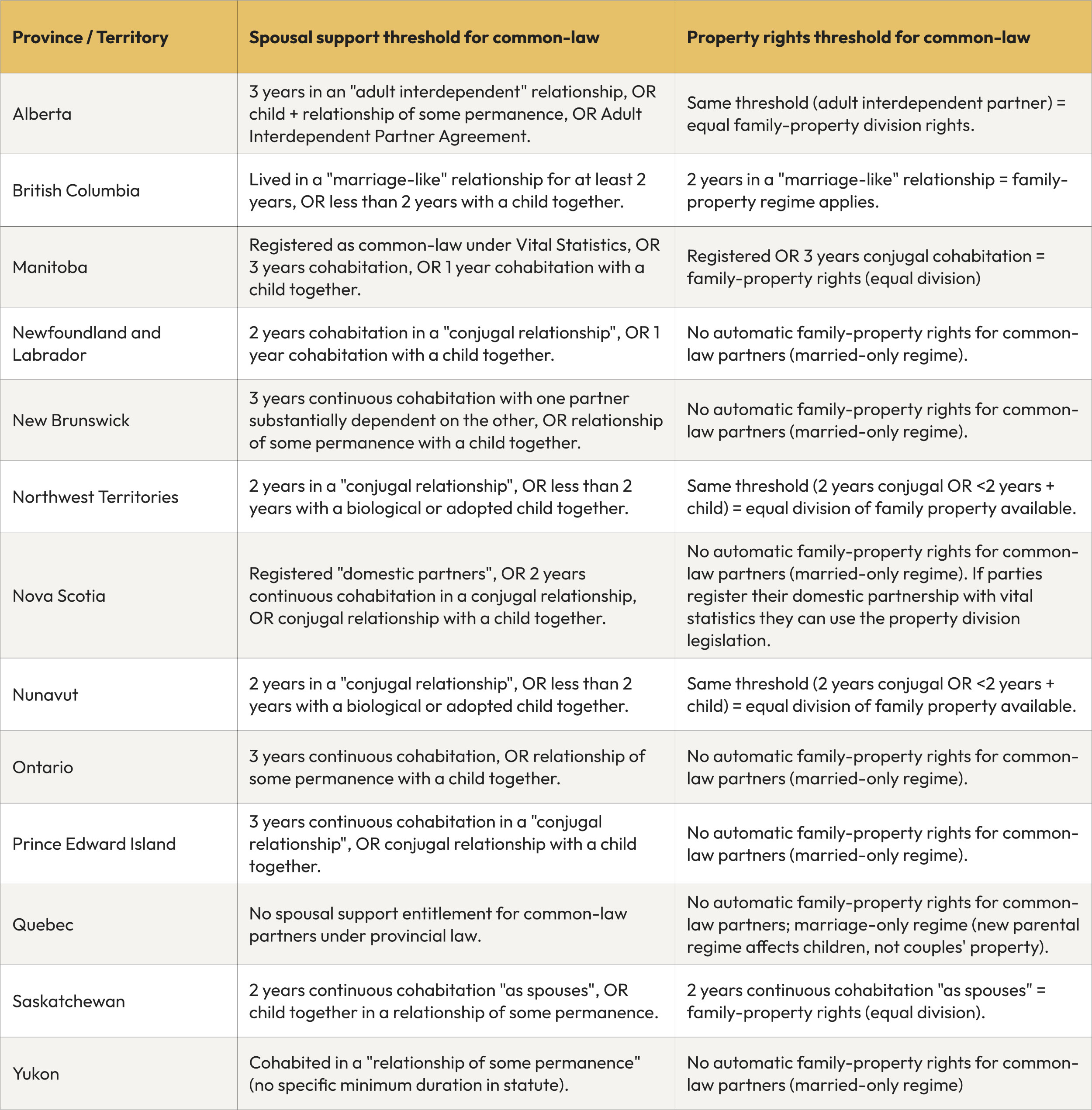
For unmarried partners there are no automatic property rights in certain provinces. Check the Property Rights Threshold in the table above for your province. If matrimonial property division legislation does not apply, the default rule is simple and stark: what's in your name is yours, and what's in your partner's name is theirs. Jointly owned property is divided according to actual ownership.
Even if you contributed significantly to an asset held in your partner's name, then you still have no automatic claim to it if you’re outside of the thresholds listed above. You may have paid for it, contributed through labour, or by taking on parenting responsibilities so the other person could build wealth, you still have no claim to an asset held in your partner’s name.
The provinces where this default does not apply — where common law partners get marriage-like property rights after meeting a cohabitation threshold — are BC, Alberta (since January 1, 2020), Saskatchewan, and Manitoba. If you live in one of these provinces and have been together long enough, your property rights may be much stronger than you realize.
The family home
For married couples, both spouses have an equal right to possession of the matrimonial home regardless of who is on title, and neither can sell or mortgage it without the other's consent.
For common law partners in provinces without automatic property division, the partner whose name is on title or the lease has the legal right to ask the other to leave. This is one of the key distinctions between a married couple and a common law couple in those provinces.
This reality is one of the most frightening aspects of common law separation for the partner who isn't on title. Courts are reluctant to see it happen in ways that cause undue hardship, and a person who has a spousal support claim may apply for temporary possession. But the protection is not automatic.
Debts
Debt rules are the same for married and common law couples. You are legally responsible for debts in your own name. Joint and co-signed debts leave both parties fully liable to creditors, regardless of what any separation agreement says. A creditor is not bound by an agreement between the two of you. If both names are on the credit card, both remain responsible to the bank.
Spousal support
Common law partners have a legal right to claim spousal support, but unlike married couples, they must first meet an eligibility threshold. In most provinces, this means either three years of living together continuously, or one year of cohabitation with a child together. Some provinces also recognize a "relationship of some permanence" with a child as sufficient. See the thresholds listed above.
Once you cross that threshold, the analysis is the same as for married couples: entitlement is assessed on compensatory grounds (you sacrificed career or opportunity to support the relationship), non-compensatory grounds (the separation leaves you in financial need), or contractual grounds (a cohabitation agreement provides for support). Amount and duration are calculated using the Spousal Support Advisory Guidelines, the same tool used for married couples.
Quebec is the notable exception: common law partners in Quebec historically had no right to spousal support at all, regardless of the length of the relationship. A new parental union regime, effective June 30, 2025, provides some protections for common law couples with children, but spousal support still does not flow automatically in Quebec for common law partners.
Source: Ontario.ca – Spousal Support
Inheritance
Married spouses typically have automatic rights to inherit a portion of their partner's estate under provincial intestate succession laws. Common law partners in most provinces have no such automatic inheritance rights. If your common law partner dies without a will, you may receive nothing, even after decades together. It’s therefore essential for common law partners to have a will, if you want to protect each other from such a situation.
Pensions
Similarly, pensions accumulated during a marriage are divisible upon divorce in most provinces. Common law partners in Ontario, Quebec, and several other provinces have no automatic right to a share of their partner's pension, unless it was jointly contributed to or they can establish an unjust enrichment claim. BC, Alberta, Saskatchewan, and Manitoba extend pension division rights to qualifying common law couples.
Children: Where the rules are the same
Where it comes to children, common law and married couples are treated largely the same. Parenting decisions and child support are handled under the provincial family legislation, which isn't always identical to the Divorce Act. However, most of the difference is specific wording and the overall effect is generally the same.
Parenting rights apply equally regardless of whether the parents were married. That includes child custody and decision-making responsibility, parenting time, and the best interests of the child framework. Child support is calculated using provincial guidelines, which again is largely the same as Federal Child Support Guidelines, but with some slightly different wording, The amount of Child Support is based on the payor's income, the number of children, and the province of residence. Marital status makes no difference whatsoever to what children are owed or to either parent's obligations.